More Than Words: Making Room for Connection at Storytime
A study of shared reading invites us to look beyond the words on the page—and think about the relationship around the book.

Some days, the hardest part of storytime is getting there.
There is dinner to clear away, a tired child to settle, and a list of things you have not quite finished. Opening a book can feel like one more thing you ought to do well.
What if you made the invitation gentler?
You don’t have to finish the chapter. You don’t have to ask the perfect question. You can begin with a place beside you and something to look at together.
A paper called Beyond Language offers a useful perspective on why the relationship around reading deserves attention too.
1. Look beyond the words on the page
Canfield and colleagues’ 2020 paper analyzed shared reading and parenting measures at child ages six and eighteen months in low-income families. Although the data came from a randomized trial, this analysis was observational.
Higher overall reading scores at six months were associated with greater later parental warmth and observed sensitivity, and a lower likelihood of reaching an at-risk parenting-stress threshold, after adjustment for baseline risk and treatment group. The authors described the effects as relatively small and could not establish causality. Read the full paper.
It did not test House of Heroes or adventures for older children. Its findings give context for thinking about shared reading; they are not a promise that a book will make parenting less stressful.
For us, the editorial takeaway is an invitation: when planning storytime, leave room for the person beside you as well as the story in front of you.
BEYOND THE WORDS
Shared reading and early relationships
Study design
Observational analysis within a larger trial
Child ages at assessment
Reported associations
Higher early overall reading scores were linked with:
- Greater later parental warmth
- Greater later observed sensitivity
- Lower likelihood of at-risk parenting stress
Keep in mind
- Effects were relatively small.
- Association does not establish causation.
- House of Heroes was not tested.
Canfield et al. (2020) · Developmental Psychology
doi:10.1037/dev0000940
View the full infographic (PNG)
2. Begin with something you can share
Choose a book you feel happy opening, and a moment when you have a little attention to give. Sit where both of you can see the pictures or pages comfortably. You might start with the cover, a familiar character, or the place where you stopped last time.
Your child does not have to participate in a particular way. They might point, offer an idea, ask for the same page again, or simply listen. You can meet that response with interest rather than trying to move the moment along.
If everyone is too tired, make the plan smaller—or try another time. This is an invitation to spend time together, not another standard to live up to.

3. Let a response become a conversation
For a little child, conversation might begin with a finger on a picture and your answer: “You found the dog.” For an older child, it might begin with a question about a character’s choice.
You can respond to what actually interests them. “You think the traveler should turn back. What makes you say that?” Or, “That creature looks lonely to you. What would your Hero do?”
Leave a pause after your question. And if they do not want to answer, carry on with the story. The invitation matters more than getting a response every time.
These are our practical suggestions, not a research-tested routine from the paper. Use the ones that fit your child and leave the others for another evening.
The story gives you somewhere to go. Sharing it gives you something to do together.
4. Give the moment a place to continue
You can end a reading session without closing the conversation completely.
Ask which character your child would like to meet, what they would change, or which moment they want to remember. Perhaps they will draw a picture. Perhaps they will tell you something while you put the book away.
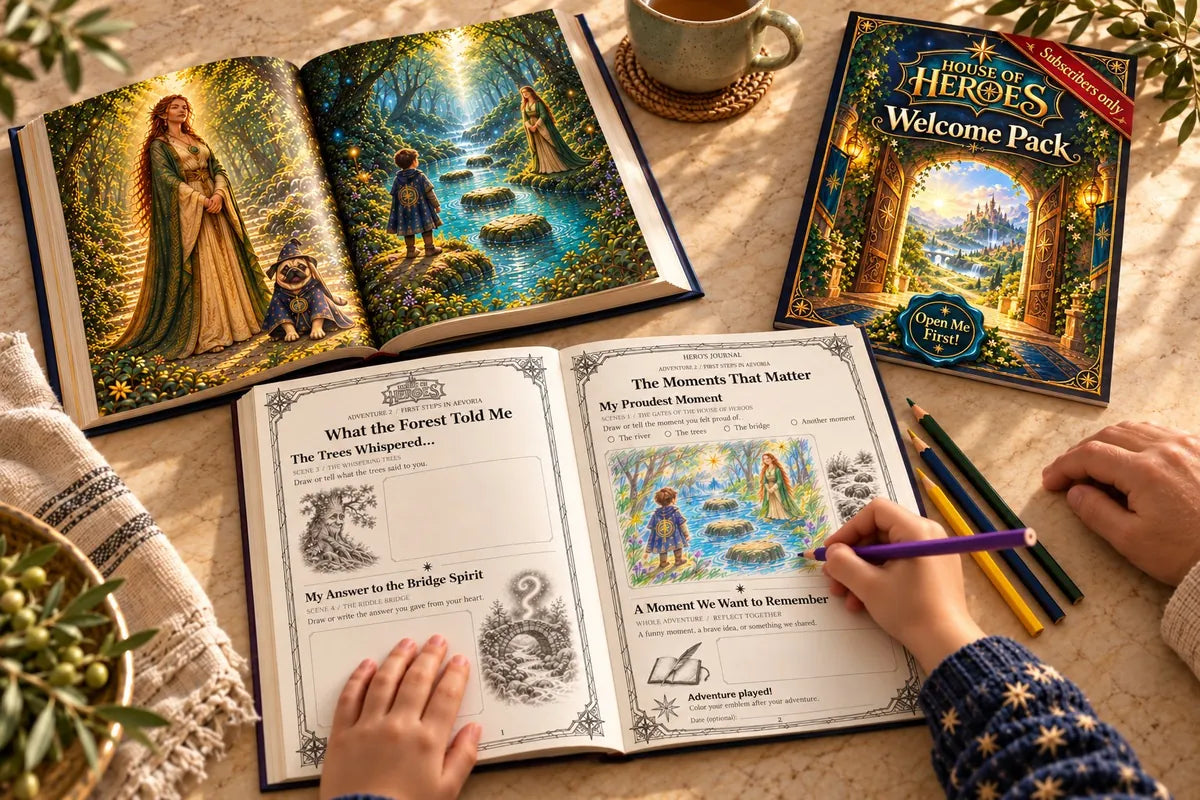
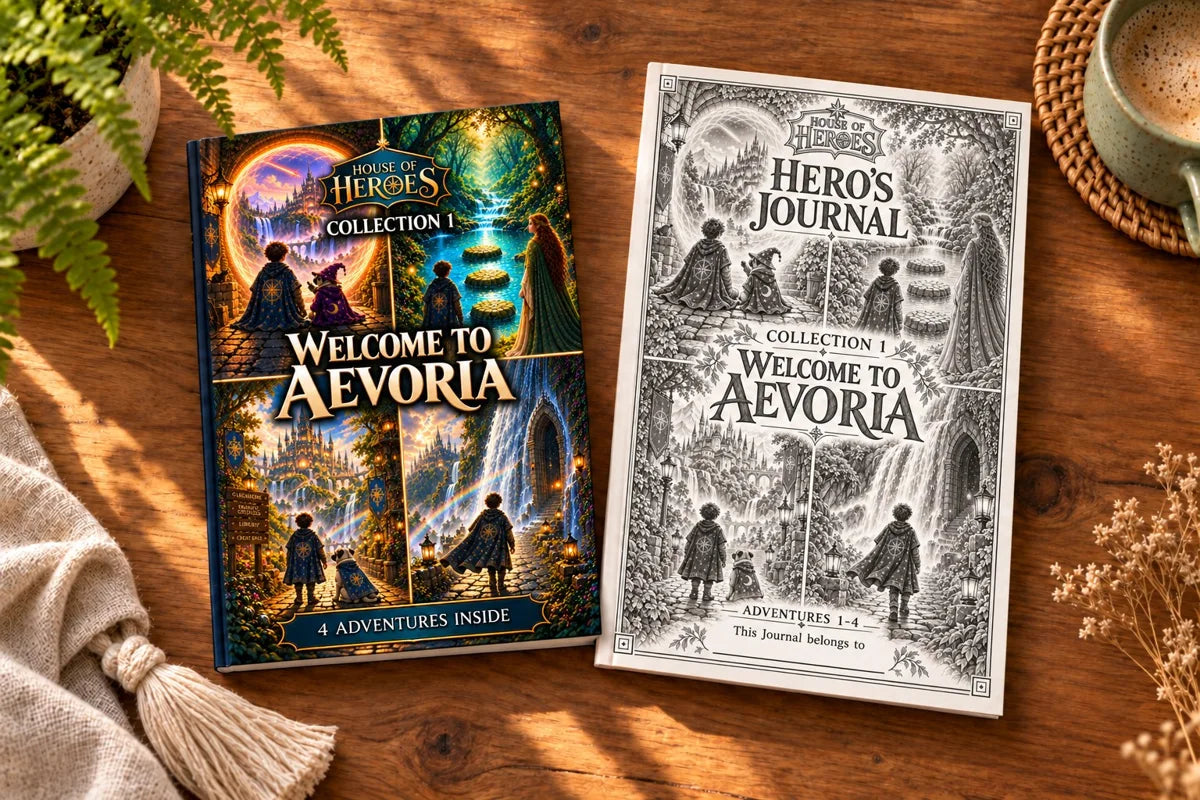
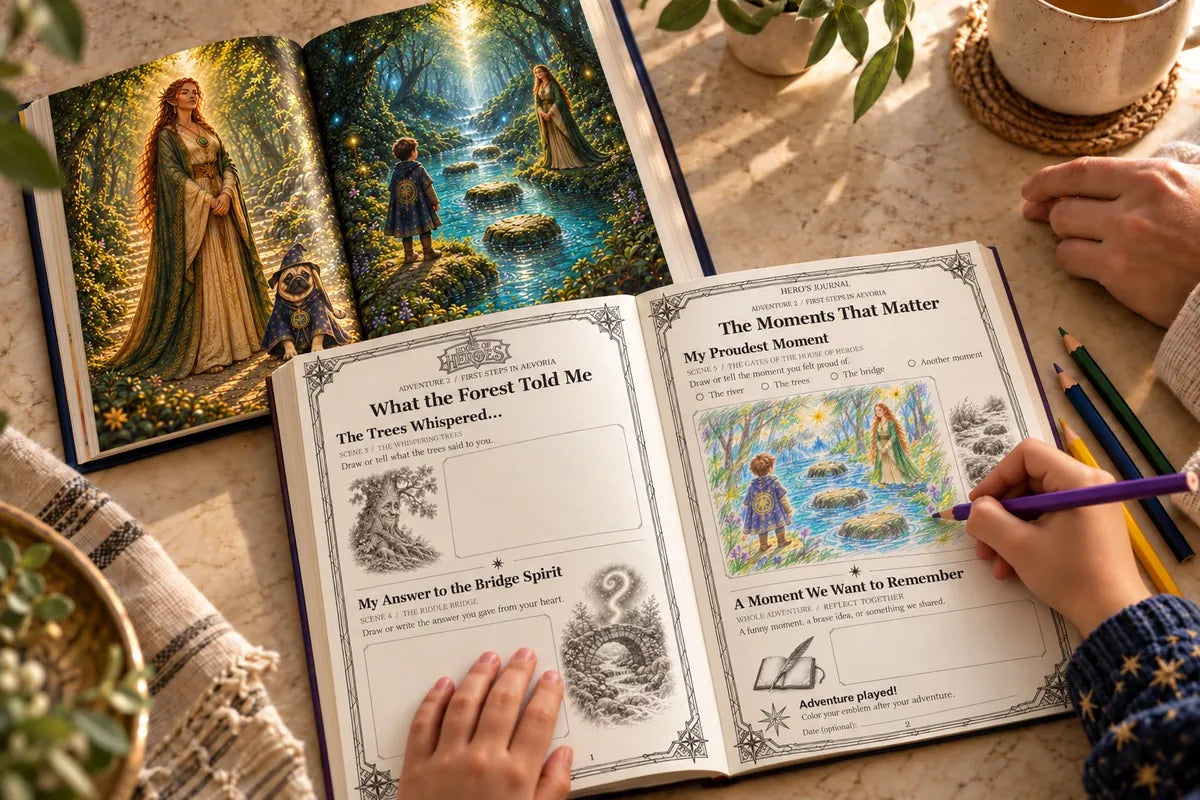
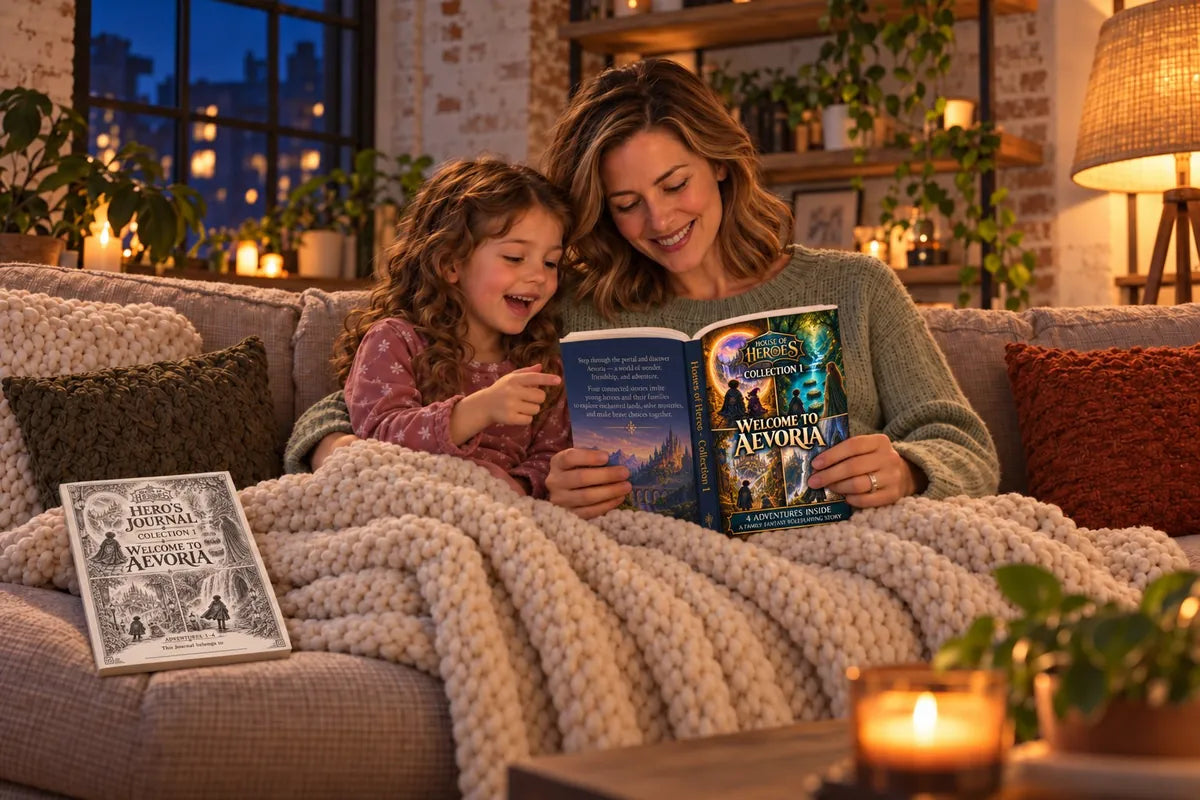
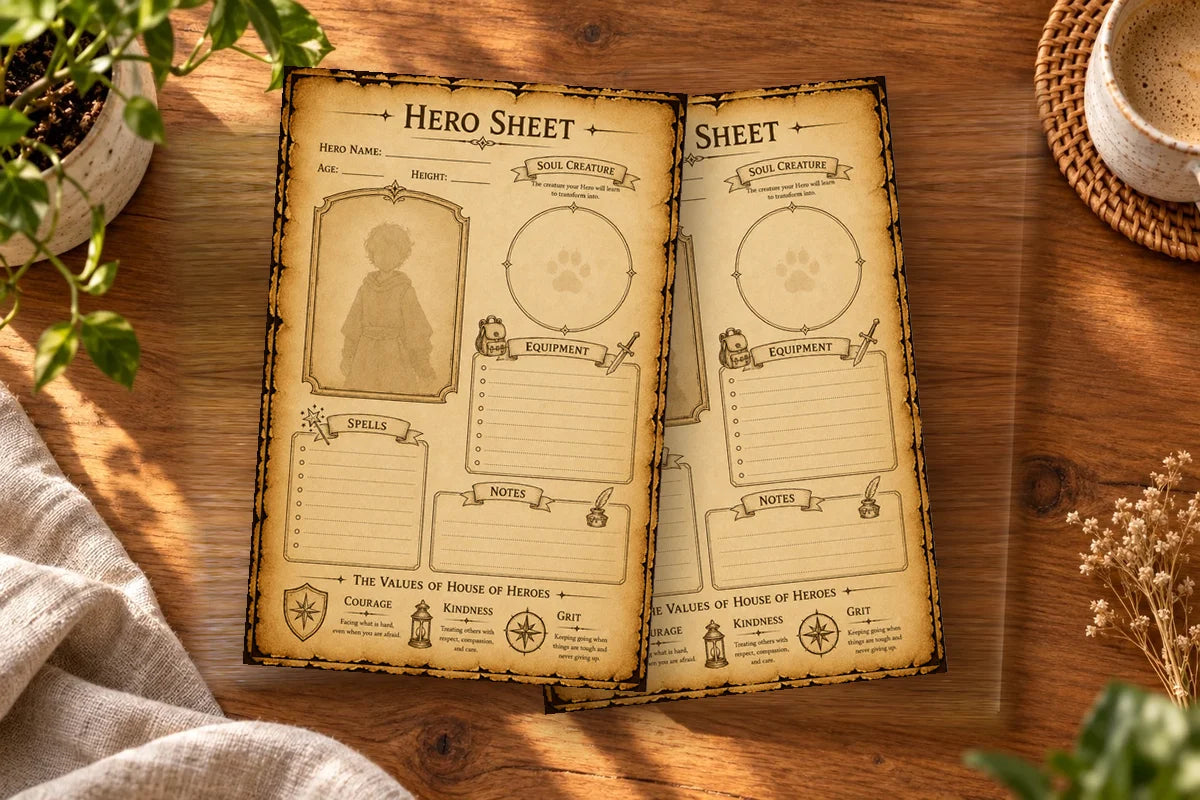
In House of Heroes, the adult reads the adventure aloud while the child becomes the Hero and makes choices that help shape the story. The companion Hero’s Journal offers a place to draw, write, and remember afterwards.
We designed those features as invitations to participate in a shared experience. The paper did not evaluate branching stories or journals, and it does not establish that those features improve relational health. The connection is our design intention: give a family a story to share and space for a child’s contribution.
5. Keep storytime gentle on yourself too
You do not need to make every reading session memorable. There can be interrupted pages, repeated questions, funny voices that fall flat, and evenings when you stop early.
A shared story does not have to become a project. It can be a few pages you enjoyed, a character you talked about, or a question you will return to another day.
Reading cannot take away every pressure a family faces. If your evening is difficult, that is not evidence that you have done storytime wrong. Choose what feels manageable and let the rest wait.
At House of Heroes, we want to offer a starting point for these moments: an adventure with a place for your child inside it, and a chance for you to explore it together. How that looks in your family belongs to you.
Research behind this story
Canfield, C. F., Miller, E. B., Shaw, D. S., Morris, P., Alonso, A., & Mendelsohn, A. (2020). Beyond Language: Impacts of Shared Reading on Parenting Stress and Early Parent-Child Relational Health. Developmental Psychology, 56(7), 1305–1315. https://doi.org/10.1037/dev0000940
The family prompts and House of Heroes connections are editorial suggestions. They should not be read as a replication of the study or evidence of product-specific benefits.